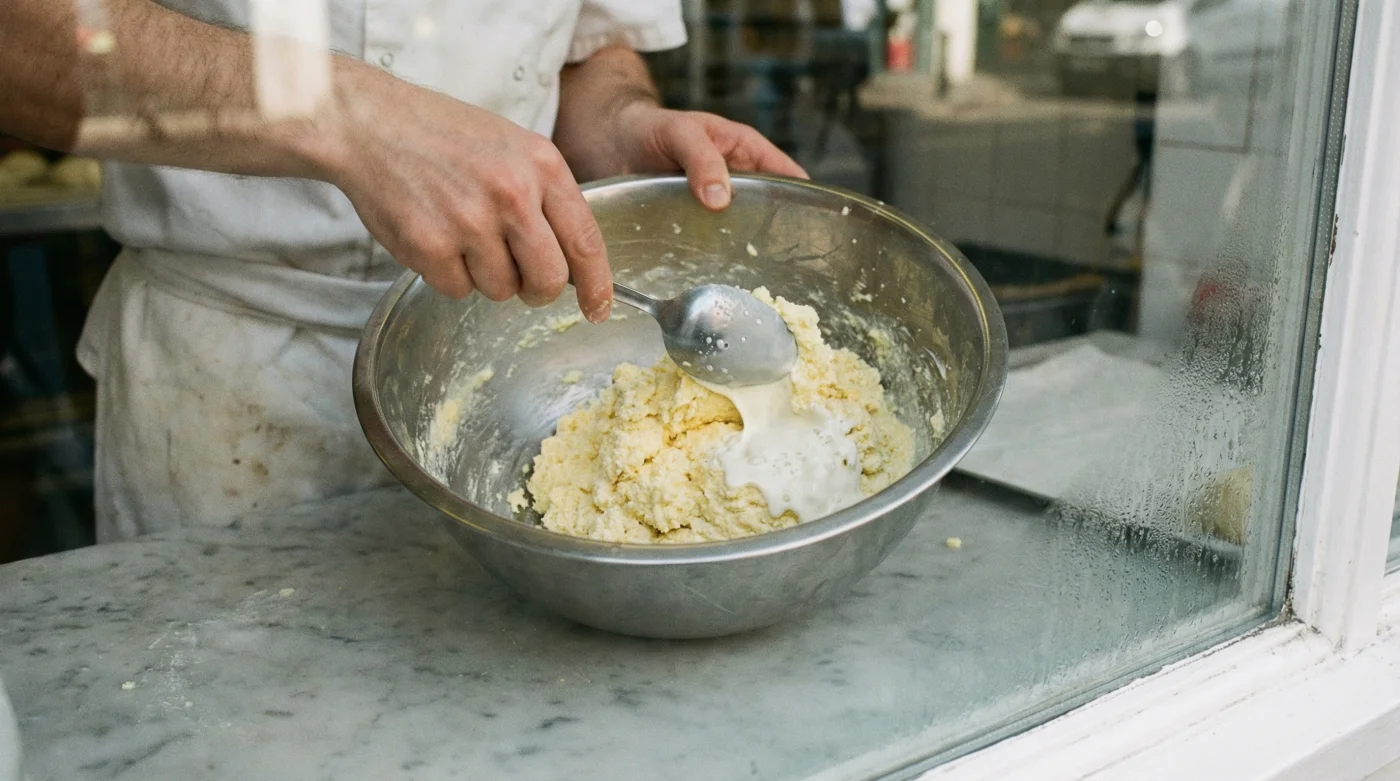
You know the exact moment it happens. The steady, rhythmic hum of the electric whisk suddenly changes pitch, taking on a heavy, slapping sound against the metal bowl. You stop the motor, lift the beaters, and your heart sinks. What was, mere seconds ago, a bowl of silken, pillowy double cream has transformed into a grainy, yellow-tinged mass. It looks somewhat like curdled milk and feels like an absolute culinary failure. The dessert course of your Sunday roast is looming, and panic sets in.
For generations, the standard domestic advice for over-whipped, split cream has been ruthless: throw it straight in the bin, or keep whipping until you accidentally make a block of butter. The belief that grainy cream is ruined is an ingrained kitchen myth. You probably assume the structural damage is permanent. But you do not need to discard it, nor do you need to rush to the local shop for an emergency replacement carton.
The Emulsion’s Fragile Truce
To understand the rescue, you must first understand the vulnerability of British double cream. Pouring it straight from the fridge gives you a liquid that is roughly 48 per cent fat, suspended in water. As you whisk, you force air into this liquid, and the fat globules smash into one another, stripping away their protective membranes. They link arms, forming a microscopic net that traps the air and the water. This is the velvet sheen of perfect soft peaks.
But push it too far, and the net collapses. The fat clumps together in a panic, squeezing the water out entirely. This is why your bowl suddenly looks split and weeping. You have not ruined the ingredients; you have simply broken the emulsion’s fragile truce.
| The Cook | The Immediate Benefit |
|---|---|
| The Anxious Host | Saves a dinner party dessert from ruin in under sixty seconds, without needing to abandon guests. |
| The Frugal Baker | Prevents the waste of expensive, high-quality dairy, keeping the weekly food budget intact. |
| The Novice Cook | Builds essential confidence by turning a stressful failure into a completely manageable, professional process. |
I learned the antidote to this panic years ago during a brutal Christmas service in a cramped Edinburgh bakery. The air was thick with the scent of cinnamon and exhausted ovens. I had just turned away from the stand mixer for exactly ten seconds to check a receipt, and my vast bowl of chantilly cream had turned to yellow gravel. I prepared to scrape the whole lot into the food waste bin.
The head pastry chef caught my arm. He did not shout; he simply reached into the fridge, poured a tiny splash of cold, unwhipped milk into the bowl, and handed me a large spatula. “Never throw away the butterfat,” he murmured. “You just need to remind it how to hold hands with the water.”
The Gentle Art of the Rescue
The solution requires nothing more than the cold milk already sitting in your fridge door and a gentle, physical mindfulness. The unwhipped milk acts as a liquid peacemaker. It introduces a fresh dose of water and intact proteins back into the bowl, giving those panicked, clumped fat globules something new to bond with.
| The Scientific Phase | The Mechanical Logic |
|---|---|
| Soft Peak | Air is perfectly trapped by a stable, flexible network of fat. The texture is smooth and pillowy. |
| The Split (Over-whipped) | Fat molecules bind too tightly, expelling water. The texture becomes grainy, heavy, and yellow. |
| The Re-emulsion | Cold milk introduces fresh liquid. Gentle folding separates the tight fat clumps back into a smooth suspension. |
To begin the rescue, pour exactly one tablespoon of cold whole or semi-skimmed milk into your bowl of split cream. Do not reach for the whisk. The whisk is what caused the trauma in the first place. Instead, take a large, flexible silicone spatula.
- Canned lentils lose vital texture and nutrients during this common rinsing habit
- Standard gravy granules achieve rich steakhouse depth with this specific pantry acid
- Over-whipped double cream returns to perfect peaks with this cold milk addition
- Bagged spinach faces urgent UK supermarket recall over hidden listeria contamination
- Cocoa powder prices surge nationwide following severe West African harvest disruptions
Almost like magic, the yellow clumps will begin to dissolve into the fresh milk. The mixture will smooth out, regaining that lost, glossy sheen. If the cream was severely over-whipped and still looks slightly textured after ten folds, add one more tablespoon of cold milk and repeat the gentle motion.
| Quality Indicator | What to Look For | What to Avoid |
|---|---|---|
| Visual Texture | A return to a smooth, opaque white gloss that holds a soft shape on the spatula. | Distinct, solid lumps of pale butter swimming in thin, watery buttermilk. |
| Physical Resistance | A light, airy resistance when pulling the spatula through the centre of the bowl. | A heavy, dragging sensation indicative of completely solidifying butterfat. |
| Milk Temperature | Fridge-cold milk, which keeps the fat firm enough to maintain the emulsion structure. | Room temperature milk, which encourages the fat to melt and grease the sides of the bowl. |
You must stop folding the second the cream looks smooth again. It will likely hold a slightly softer peak than your original goal, making it perfect for spooning over warm puddings or sandwiching between Victoria sponges. If you push your luck and continue stirring, the structure will collapse permanently.
Kitchen Forgiveness
There is a profound comfort in learning how to reverse a mistake. So much of cooking is framed as a high-wire act where one misstep spells disaster. We are conditioned to believe that ruined food must be punished with the bin. But learning this simple, milk-folding technique changes the atmosphere of your kitchen.
It transforms a moment of high stress into a quiet ritual of repair. You learn to read the ingredients rather than blindly following a timer. You begin to understand that a split emulsion is not a failure of character, but simply a physical reaction waiting for its counter-reaction.
The next time the whisk gets away from you, and that dreaded slapping sound echoes from the bowl, take a breath. Reach for the cold milk. In less than a minute, you can smooth over the cracks, salvage your dessert, and bring a beautiful, silken finish to the table, with nobody any the wiser.
“A broken emulsion is never the end of the road; it is simply the recipe asking for a little patience and a drop of cold milk.”
Frequent Curdling Queries
Can I use skimmed milk to fix split cream? Yes, but whole milk is superior because it contains its own fat, which helps bridge the gap more effectively, though any cold milk will provide the necessary hydration.
Does this work if the cream has fully turned to butter? No. If you have solid yellow lumps separating from a thin, watery liquid (buttermilk), you have made butter. Wash it, salt it, and spread it on toast, but it can no longer be cream.
Can I use an electric whisk on the lowest setting instead of a spatula? It is highly discouraged. The electric whisk applies too much friction and speed, even on low; hand-folding is the only way to control the delicate re-emulsification.
Will adding milk change the flavour of my whipped cream? Not at all. The volume of milk used (one to two tablespoons) is so small compared to the heavy cream that the rich, dairy flavour profile remains entirely unaltered.
Can I fix split mascarpone or cream cheese frostings the same way? Yes. The underlying principle of reintroducing a small amount of cold hydration works beautifully to smooth out grainy, fat-heavy frostings.